> ## Documentation Index
> Fetch the complete documentation index at: /llms.txt
> Use this file to discover all available pages before exploring further.
# CI runners
> Build your own CI on boxd: every push and pull request runs on fresh machines created from a snapshot of main's last green run.
CI as one [automation](/guides/automations/scripts.md) and a config file: every push and pull request runs on fresh machines created from a snapshot of main's last green run, and reports a GitHub check. Both files are [below](#the-complete-files).
A push to main: nine 2 vCPU machines, green in under two and a half minutes, saved as the next snapshot. Waits are cut short.
## Why run CI on boxd
* **The machine is the cache.** Jobs start from a [snapshot](/guides/snapshots.md) with the repo, dependencies, build caches and Docker layers in place.
* **No idle runners.** Machines exist only while a job runs, metered per second.
* **Parallel by default.** Each test shard gets its own machine, with no setup to repeat.
* **Isolated.** Job machines hold no credentials, so pull request code can't reach your organization.
* **A real machine.** Docker, systemd and Postgres run normally.
## What you build
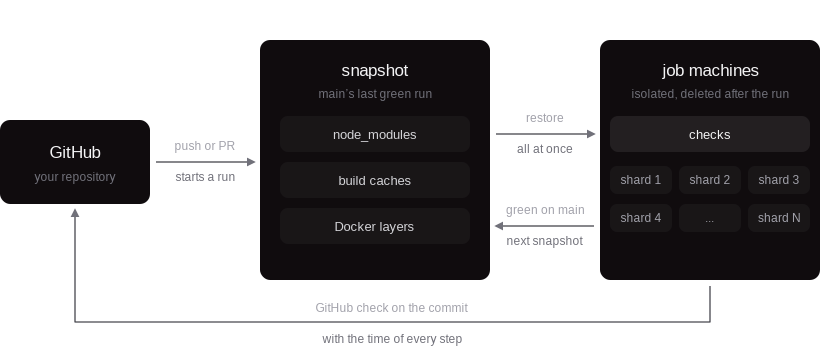
You need the [boxd GitHub App](/guides/integrations/connections.md#github-app) on the repository, and one machine to run the automation on. That machine can sleep: an event wakes it.
## 1. Snapshot your repo
GitHub triggers the run and shows the result. boxd runs it, with no workflow file and no Actions minutes.
Set up a machine the way a job should find it, then save it.
```bash
boxd new web-ci
boxd connect web-ci
```
Inside the machine:
```bash
mkdir -p ~/work && cd ~/work
gh repo clone acme/web && cd web
yarn install --frozen-lockfile
yarn lint --cache && yarn typecheck --incremental # builds the caches
exit
```
Back on your laptop:
```bash
boxd snapshots save web-ci web-main
```
You do this once. After that, green runs on `main` save the next version ([step 6](#6-promote-a-green-main)).
## 2. Describe your CI
One entry per repository:
```json ci.json
{
"acme/web": {
"snapshot": "web-main",
"workdir": "/home/boxd/work/web",
"on": { "push": ["main"], "pull_request": true },
"setup": [
"git diff --quiet \"$BASE\" HEAD -- yarn.lock || yarn install --frozen-lockfile"
],
"checks": [
"yarn lint --cache",
"yarn typecheck --incremental"
],
"fanout": { "command": "yarn test --shard={i}/{n}", "n": 8 },
"promote": "main"
}
}
```
| Key | What it does |
| - | - |
| `setup` | Runs on every machine after checkout. `$BASE` is the snapshot's commit, so install is skipped when the lockfile is unchanged. |
| `checks` | Run in order on the first machine. |
| `fanout` | One more machine per shard, each running `command` with `{i}` and `{n}` filled in. |
| `promote` | The branch whose green runs become the next snapshot. |
## 3. Start a run on every push and pull request
Subscribe to events through the GitHub App. There is no webhook to host:
```typescript ci.run.ts
import { boxd, githubApp } from "@boxd/run";
import config from "./ci.json";
githubApp.on("push", { repo: "acme/web" }, async (e) => {
const branch = e.ref.replace("refs/heads/", "");
if (branch === "main") await ci(e.after, branch);
});
githubApp.on("pull_request", { repo: "acme/web" }, async (e) => {
if (["opened", "synchronize", "reopened"].includes(e.action))
await ci(e.pull_request.head.sha, e.pull_request.head.ref);
});
```
## 4. Create a machine per job
Create an isolated machine from the snapshot and check out the commit. The GitHub App token is short-lived and exists only in the fetch command's environment:
```typescript
async function prepare(name: string, sha: string) {
const m = await boxd.machines.create({ name, fromSnapshot: snapshot, isolated: true });
await boxd.machines.waitUntilReady(m.id);
const token = await githubApp.getToken();
await boxd.machines.exec(m.id, {
command: ["bash", "-lc", `cd ${workdir} && git -c http.extraheader="AUTHORIZATION: basic $AUTH" fetch -q origin ${sha} && git checkout -q -f ${sha}`],
env: { AUTH: btoa(`x-access-token:${token}`) },
});
for (const step of repo.setup) await run(m, step);
return m;
}
```
The snapshot already holds main's checkout, so the fetch brings only the new commits.
## 5. Run everything at once
One machine for the checks and one per shard, all created together:
```typescript
async function ci(sha: string, branch: string) {
const { n, command } = repo.fanout;
const shards = Array.from({ length: n }, async (_, i) => {
const m = await prepare(`ci-${sha.slice(0, 7)}-s${i + 1}`, sha);
return run(m, command.replace("{i}", `${i + 1}`).replace("{n}", `${n}`));
});
const main = await prepare(`ci-${sha.slice(0, 7)}`, sha);
let ok = true;
for (const step of repo.checks) ok &&= await run(main, step);
ok &&= (await Promise.all(shards)).every(Boolean);
await report(sha, ok); // a GitHub check, next step
if (ok && branch === repo.promote) await promote(main);
// every machine except a promoted one is deleted here
}
```
A pull request: checks and 8 test shards on nine 2 vCPU machines, green in 145 seconds. Waits are cut short.
Report the result as a check on the commit:
```typescript
const gh = await githubApp.client();
await gh.rest.checks.create({
owner, repo: name, name: "boxd-ci", head_sha: sha,
status: "completed", conclusion: ok ? "success" : "failure",
output: { title: ok ? "green on boxd" : "failed", summary: stepTable },
});
```
## 6. Promote a green main
After a green run on `main`, the machine holds the state the next job should start from. Save it once the result is reported, so nobody waits on the save:
```typescript
async function promote(machine) {
await boxd.snapshots.create(machine.id, next);
// create() returns while the copy is still running, and the copy reads from
// the live machine: keep it until the snapshot is ready.
let snap = await boxd.snapshots.get(next);
while (snap.status !== "ready") {
await sleep(1000);
snap = await boxd.snapshots.get(next);
}
snapshot = next; // the next run starts from it
await boxd.machines.delete(machine.id);
}
```
Pull requests never write to the snapshot.
> [!NOTE]
>
> A snapshot can't be used to create machines while it saves a new version. Keep two names (`web-main` and `web-main-b`), save into the idle one, then switch.
## 7. Turn it on
```bash
run ci.run.ts
```
The config, then the automation started with one command.
```text
boxd-ci watching acme/web
2f5c7: running in the background — `run logs 2f5c7` to follow
```
Push a commit and follow the run with `run logs 2f5c7 -f`:
```text
▶ push to main · f9add68 · 9 machines from web-main
4.2s ✓ 9 machines restored from the snapshot, each booted in 4–290ms
8.5s ✓ lint (4.3s)
14.3s ✓ typecheck (4.2s)
79.5s ✓ shard 5/8 (74.2s)
...
143.0s ✓ shard 6/8 (138.2s)
144.3s ✓ green: check posted on f9add68
★ saved as web-main-b@6 in 4.2s: the next job starts here
```
## The complete files
Copy both into a folder on one of your machines, edit `ci.json`, and start with `run ci.run.ts`.
> [accordion] ci.json
>
> ```json ci.json
> {
> "acme/web": {
> "snapshot": "web-main",
> "workdir": "/home/boxd/work/web",
> "on": { "push": ["main"], "pull_request": true },
> "setup": [
> "git diff --quiet \"$BASE\" HEAD -- yarn.lock || yarn install --frozen-lockfile"
> ],
> "checks": [
> "yarn lint --cache",
> "yarn typecheck --incremental"
> ],
> "fanout": { "command": "yarn test --shard={i}/{n}", "n": 8 },
> "promote": "main"
> }
> }
> ```
> [accordion] ci.run.ts
>
> ```typescript ci.run.ts
> // ci.run.ts — CI that runs on boxd, configured outside GitHub.
> //
> // run ci.run.ts (on any of your machines; the platform holds the
> // GitHub trigger and wakes it on an event)
> //
> // GitHub only sends the event and shows the result. For every push or pull
> // request on a configured repo:
> //
> // 1. restore a fresh, isolated machine from the repo's snapshot
> // (main's last green state: checkout, node_modules, caches, Docker layers)
> // 2. fetch and check out the commit; run the setup steps
> // 3. at the same moment, restore one more machine per test shard from the
> // same snapshot; each checks out and runs its slice of the tests while
> // the checks run on the first
> // 4. report a GitHub check run on the commit
> // 5. green on main: save the machine as the next version (two snapshot
> // names, alternating, so the last one stays restorable while one saves).
> // Anything else is destroyed.
> //
> // No runners, no pools: every job is a restore from a snapshot, in milliseconds.
> import { boxd, githubApp, object } from "@boxd/run";
> import config from "./ci.json";
>
> type Repo = {
> snapshot: string;
> workdir: string;
> on: { push?: string[]; pull_request?: boolean };
> setup: string[];
> checks: string[];
> fanout?: { command: string; n: number };
> promote?: string;
> };
> const repos = config as Record;
>
> /** Which of the two snapshot names jobs restore from, per repo. Survives restarts. */
> const state = object<{ active: Record }>("boxd-ci");
> state.active ??= {};
> // A stored name only counts while it belongs to the configured snapshot, so
> // pointing a repo at a new snapshot in ci.json takes effect.
> const active = (repo: string) => {
> const a = state.active[repo];
> return a === repos[repo].snapshot || a === `${repos[repo].snapshot}-b` ? a : repos[repo].snapshot;
> };
> const other = (repo: string) => (active(repo) === repos[repo].snapshot ? `${repos[repo].snapshot}-b` : repos[repo].snapshot);
> const promotions = new Map>();
>
> const secs = (t0: number) => ((performance.now() - t0) / 1000).toFixed(1);
> const sleep = (ms: number) => new Promise((r) => setTimeout(r, ms));
>
> type Step = { name: string; ok: boolean; s: string; tail?: string };
>
> async function sh(id: string, dir: string, script: string, env?: Record, timeout = 30 * 60_000) {
> return boxd.machines.exec(id, { command: ["bash", "-lc", `cd ${dir} && ${script}`], env, timeout });
> }
>
> async function step(steps: Step[], name: string, id: string, dir: string, script: string, env?: Record, say?: (m: string) => void) {
> const t0 = performance.now();
> const r = await sh(id, dir, script, env);
> const out = `${r.stdout}\n${r.stderr}`.trim().split("\n");
> steps.push({ name, ok: r.success, s: secs(t0), tail: r.success ? undefined : out.slice(-40).join("\n") });
> say?.(`${r.success ? "✓" : "✗"} ${name} (${secs(t0)}s)`);
> return r.success;
> }
>
> /** The short form of a step for the live log: `yarn test:code --cache …` → `test:code`,
> `pnpm run lint` → `lint`; anything else is the command itself, cut to 48 characters. */
> const short = (cmd: string) =>
> cmd.match(/(?:yarn|pnpm|npm|bun)(?: run)? ([\w:.-]+)/)?.[1] ?? (cmd.length > 48 ? `${cmd.slice(0, 47)}…` : cmd);
>
> async function ci(repoName: string, sha: string, ref: string, isMain: boolean, label: string, shards?: number) {
> const repo = repos[repoName];
> const [owner, name] = repoName.split("/");
> const gh = await githubApp.client();
> const t0 = performance.now();
> // The live log, `run logs -f`: one line per event, timed from the push.
> const say = (msg: string) => console.log(`${secs(t0).padStart(6)}s ${msg}`);
> const check = await gh.rest.checks.create({ owner, repo: name, name: "boxd-ci", head_sha: sha, status: "in_progress", started_at: new Date().toISOString() });
> const steps: Step[] = [];
> const machines: string[] = [];
> let ok = false;
> let keep: string | undefined; // the machine to save as the next snapshot
> let restore = "";
> const source = active(repoName); // the snapshot this job restores from
> const n = repo.fanout ? (shards ?? repo.fanout.n) : 0;
> const boots: number[] = [];
> console.log(`\n▶ ${label} · ${sha.slice(0, 7)} · ${n + 1} machines from ${source}`);
> try {
> const token = await githubApp.getToken();
> const jobName = `ci-${sha.slice(0, 7)}-${Date.now() % 100000}`;
>
> // One machine, restored from main's last green state, with the commit on
> // top. Isolated: no boxd CLI, no integrations, so the code under test can't
> // reach the account. The App token is only in the fetch's environment.
> // `log` decides whether its checkout and setup show up as their own rows.
> const prepare = async (machineName: string, log: boolean) => {
> const tr = performance.now();
> const m = await boxd.machines.create({ name: machineName, fromSnapshot: source, isolated: true });
> machines.push(m.id);
> // A large or fresh snapshot can answer before the machine is up.
> await boxd.machines.waitUntilReady(m.id);
> const restored = `${secs(tr)}s`;
> // create() answers before the boot is recorded: read it back.
> const boot = m.bootTimeMs ?? (await boxd.machines.get(m.id).catch(() => null))?.bootTimeMs ?? null;
> if (boot != null) boots.push(boot);
> else boots.push(-1);
> if (boots.length === n + 1) {
> const known = boots.filter((b) => b >= 0);
> say(`✓ ${n + 1} machines restored from the snapshot${known.length ? `, each booted in ${Math.min(...known)}–${Math.max(...known)}ms` : ""}`);
> }
> const prep: Step[] = log ? steps : [];
> const base = (await sh(m.id, repo.workdir, "git rev-parse HEAD")).stdout.trim(); // the snapshot's commit
> const fetched = await step(prep, `checkout ${sha.slice(0, 7)}`, m.id, repo.workdir,
> `git -c http.extraheader="AUTHORIZATION: basic $(printf 'x-access-token:%s' "$GH_APP_TOKEN" | base64 -w0)" fetch -q origin ${sha} && git checkout -q -f ${sha}`,
> { GH_APP_TOKEN: token });
> let ready = fetched;
> for (const s of repo.setup) if (ready) ready = await step(prep, s, m.id, repo.workdir, s, { BASE: base });
> if (!ready && !log) steps.push(...prep.filter((x) => !x.ok).map((x) => ({ ...x, name: `${machineName}: ${x.name}` })));
> return { m, restored, ready };
> };
>
> // The main machine runs the checks; every test shard gets its own machine,
> // restored from the same snapshot at the same moment. Nothing waits on
> // anything else.
> // A shard that cannot get its machine (an org VM limit, say) fails the
> // run. Left uncaught, its rejection would take the whole automation down.
> const shards = Array.from({ length: n }, (_, i) => (async () => {
> try {
> const { m, ready } = await prepare(`${jobName}-s${i + 1}`, false);
> if (!ready) return false;
> const cmd = repo.fanout!.command.replaceAll("{i}", String(i + 1)).replaceAll("{n}", String(n));
> return await step(steps, `shard ${i + 1}/${n}`, m.id, repo.workdir, cmd, undefined, say);
> } catch (e) {
> steps.push({ name: `shard ${i + 1}/${n}`, ok: false, s: secs(t0), tail: e instanceof Error ? e.message : String(e) });
> return false;
> }
> })());
> const main = await prepare(jobName, true);
> restore = main.restored;
> let checksOk = main.ready;
> if (checksOk) for (const s of repo.checks) if (!(await step(steps, short(s), main.m.id, repo.workdir, s, undefined, say))) { checksOk = false; break; }
> ok = checksOk && (await Promise.all(shards)).every(Boolean);
> const m = main.m;
>
> // 5. Green on main: this machine becomes the next snapshot, after the
> // result is reported (see finally). It is kept out of the cleanup.
> if (ok && isMain && repo.promote) keep = m.id;
> } catch (e) {
> steps.push({ name: "boxd-ci", ok: false, s: secs(t0), tail: e instanceof Error ? e.message : String(e) });
> } finally {
> await Promise.all(machines.filter((id) => id !== keep).map((id) => boxd.machines.delete(id).catch(() => {})));
> const total = secs(t0);
> const failed = steps.find((s) => !s.ok);
> const rows = steps.map((s) => `| ${s.ok ? "✓" : "✗"} | \`${s.name}\` | ${s.s}s |`).join("\n");
> await gh.rest.checks.update({
> owner, repo: name, check_run_id: check.data.id,
> status: "completed", conclusion: ok ? "success" : "failure", completed_at: new Date().toISOString(),
> output: {
> title: ok ? `green in ${total}s on boxd` : `failed: ${failed?.name ?? "?"}`,
> summary: `${label}. Restored from \`${source}\` in ${restore || "?"}; ${repo.fanout ? `${n} test shards, each on its own machine restored from the same snapshot; ` : ""}${total}s in total.\n\n| | step | time |\n|---|---|---|\n${rows}`,
> text: failed?.tail ? `\`\`\`\n${failed.tail.slice(-60_000)}\n\`\`\`` : undefined,
> },
> });
> say(`${ok ? "✓ green" : "✗ failed"}: check posted on ${sha.slice(0, 7)}`);
> }
> // Reported first, saved after: nobody waits on the snapshot.
> if (keep) {
> const machine = keep;
> console.log(` green on main: saving this machine as the next snapshot…`);
> const prev = promotions.get(repoName) ?? Promise.resolve();
> const next = prev
> .then(() => promote(repoName, machine))
> .catch((e) => console.log(`✗ promote: ${e instanceof Error ? e.message : e}`))
> .finally(() => boxd.machines.delete(machine).catch(() => {}));
> promotions.set(repoName, next);
> await next;
> }
> }
>
> async function promote(repoName: string, machineId: string) {
> const t0 = performance.now();
> const target = other(repoName);
> const before = await boxd.snapshots.get(target).catch(() => null);
> await boxd.snapshots.create(machineId, target);
> // The copy reads from the live machine: keep it until the snapshot is ready.
> let snap = await boxd.snapshots.get(target);
> while (snap.status !== "ready" || (snap.version ?? 0) <= (before?.version ?? 0)) {
> await sleep(1000);
> snap = await boxd.snapshots.get(target);
> }
> state.active = { ...state.active, [repoName]: target };
> console.log(` ★ saved as ${target}@${snap.version} in ${secs(t0)}s: the next job starts here`);
> }
>
> for (const [repoName, repo] of Object.entries(repos)) {
> if (repo.on.push?.length) {
> githubApp.on("push", { repo: repoName }, async (e: any) => {
> const branch = String(e.ref).replace("refs/heads/", "");
> if (!repo.on.push!.includes(branch) || e.deleted) return;
> // "[shards=16]" in the commit message overrides the shard count for that run.
> const asked = /\[shards=(\d+)\]/.exec(e.head_commit?.message ?? "");
> await ci(repoName, e.after, branch, branch === repo.promote, `push to ${branch}`, asked ? Number(asked[1]) : undefined);
> });
> }
> if (repo.on.pull_request) {
> githubApp.on("pull_request", { repo: repoName }, async (e: any) => {
> if (!["opened", "synchronize", "reopened"].includes(e.action)) return;
> await ci(repoName, e.pull_request.head.sha, e.pull_request.head.ref, false, `pull request #${e.number}`);
> });
> }
> }
> console.log(`boxd-ci watching ${Object.keys(repos).join(", ")}`);
> ```
## How fast is it
On the CI of 10 open-source projects, with 2 vCPU machines everywhere, boxd is **6× faster** than one job on a GitHub-hosted runner, **5× faster** than one job on Blacksmith and **7× faster** than one task on Vercel CI (medians).
> [card] [CI runner benchmarks](/use-cases/ci-runners/benchmarks.md)
>
> Every project on every platform, one job and sharded, with what a run costs and how it was measured.
## Good to know
* **The slowest shard sets the time.** Split tests by measured duration, or add shards.
* **More machines, not faster cores.** A boxd vCPU is about as fast as a hosted one. The time comes from the snapshot and from shards running side by side.
* **Machine size comes from the snapshot.** Jobs get the size of the machine you saved. Resize it before saving to change that.
* **Steps are plain commands.** Marketplace actions (`uses:`) don't apply.
* **Warm state can hide problems.** A dependency removed from `package.json` can still be in the snapshot, so a job passes where a clean clone would fail. Run a cold build regularly, for example nightly, to catch that.